Research Overview
My research focuses on understanding new phases of matter that emerge from strong electron–electron interactions. In these systems, collective quantum behavior dominates and makes predictive models exceptionally challenging. Understanding this physics could enable the design of materials with exotic properties for next-generation technologies such as superconductors, quantum computers, low-power electronics, and sensors.
Imaging Electron-Hole Asymmetry in the Quantum Melting of Generalized Wigner Crystals
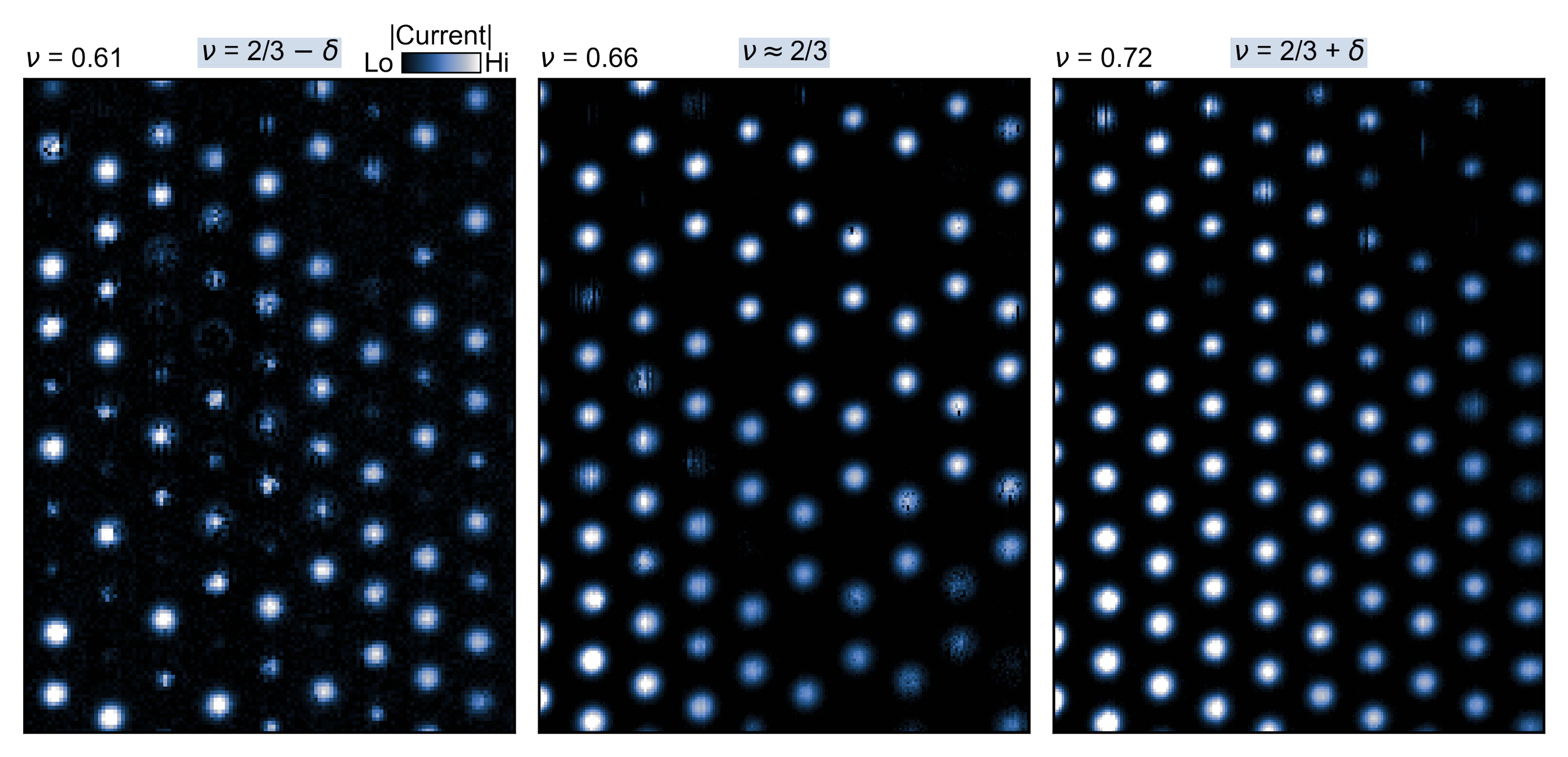
Two-dimensional moire materials provide a versatile platform to explore phase transitions in strongly correlated systems. Using scanning tunneling microscopy (STM), we imaged the density-driven melting of electron crystals (called Generalized Wigner Crystals (GWCs)) in twisted MoSe2 moire bilayers. We observed striking electron-hole asymmetry in GWC melting. For instance, the n = 2/3 GWC (center) melts into an interaction-driven disordered states upon hole-doping (left) whereas electron-doping yields delocalized liquid-like states (right). This asymmetry arises from the broken particle-hole symmetry of the moire superlattice, which produces electron and hole Fermi pockets with different momentum geometries upon GWC condensation. This work provides direct visualization of the novel emergent phases that appear as GWCs undergo quantum melting transitions. (arXiv link)
Quantum Densification of a Wigner Crystal in a weak periodic background potential
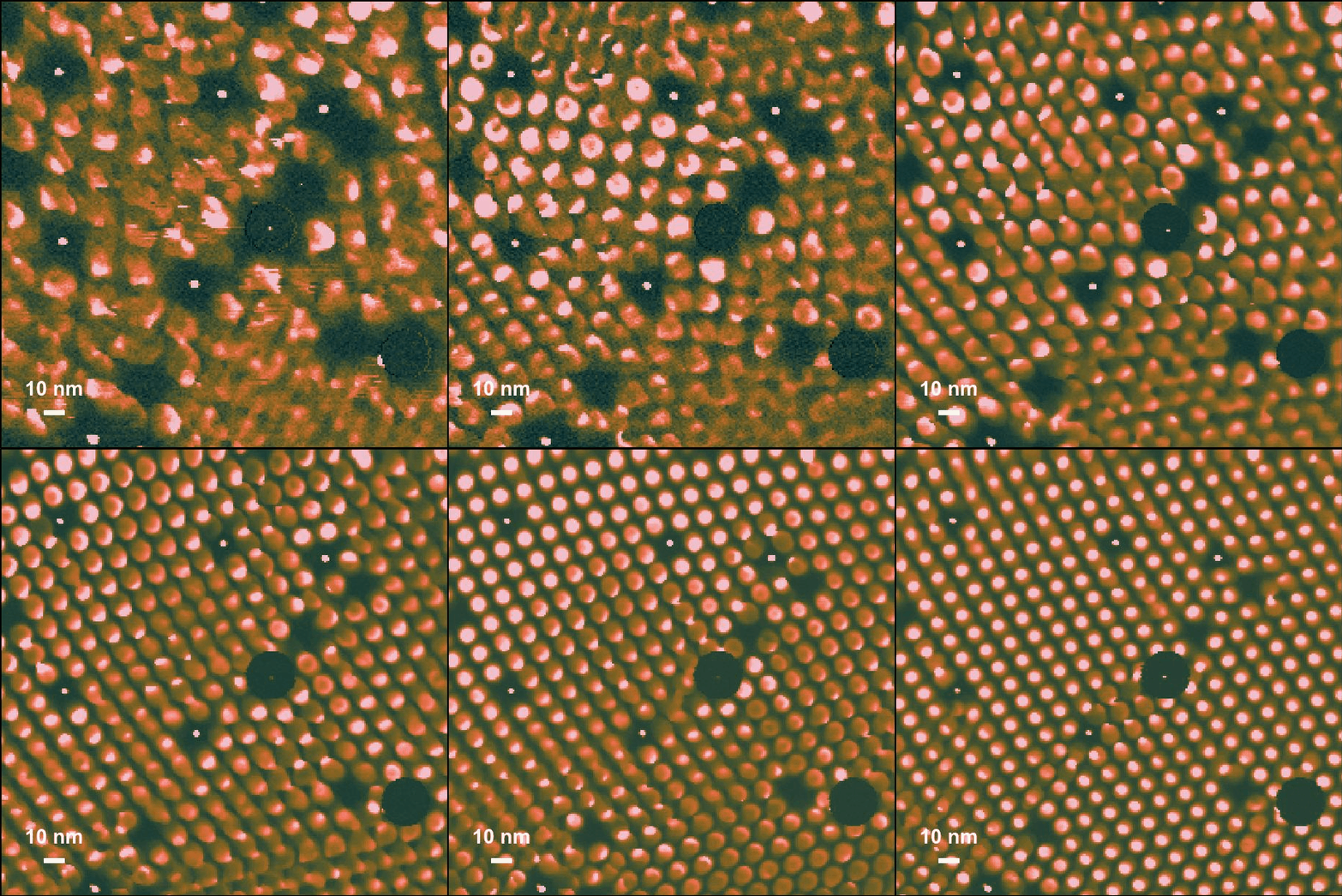
Electrons confined to two dimensions can form a striking phase of matter called a "Wigner crystal," where mutual repulsion forces them into a well-defined lattice. An open question is how this electron crystallization is shaped by a weak periodic potential in the background. Here, I show images of Wigner crystal formation in a twisted WSe₂ device, where the moiré pattern provides precisely this weak periodic landscape. As electron density increases, the crystal locks into certain lattice directions while remaining more fluid in others. Strikingly, local strain variations and charge defects create puddles of enhanced electron localization, revealing how imperfections sculpt the crystalline order.
Wigner molecules Crystals in Moire Superlattices
Wigner molecules in moiré superlattices are tiny clusters of electrons that crystallize into geometric patterns due to their mutual repulsion. These form when two atomically-thin materials are stacked with a slight misalignment, creating a periodic "egg carton" landscape that traps electrons in regularly spaced wells. The trapped electrons self-organize into precise shapes like triangles, which can collectively arrange into exotic crystal structures, emerging from a delicate balance between quantum effects, the moiré landscape, and electrical repulsion between electrons.

N = 1 N = 2 N = 3 N = 4 N = 5 N = 6 N = 7
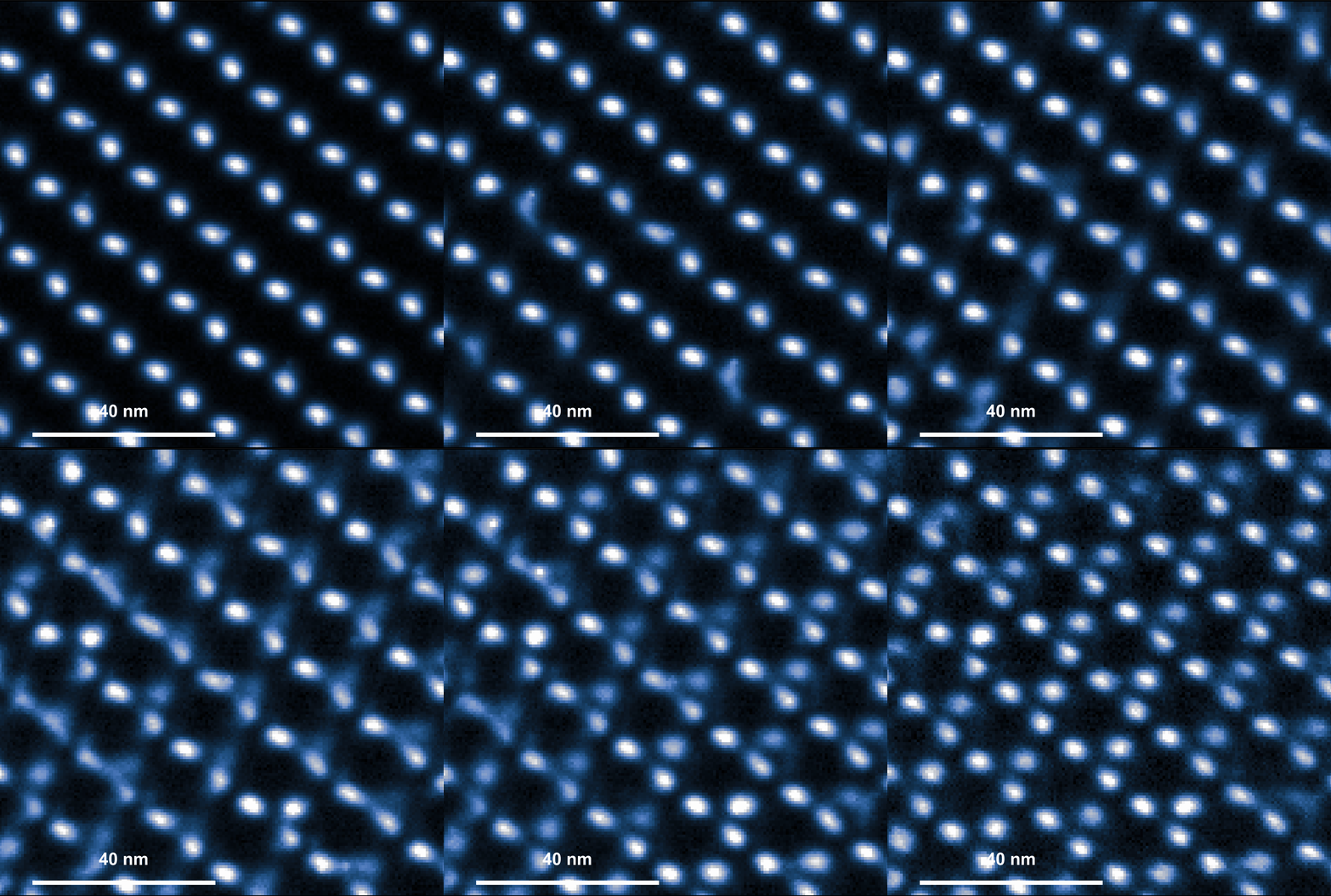
Above: Wigner molecular crystals in a twisted MoSe2 heterostructure. As the electron density is increased (from left to right), Wigner molecules form that consist of N = 1 to N = 7 electrons per unit cell. The combination of the background moire potential and the repulsive Coulomb interaction between electrons gives rise to the patterns observed.
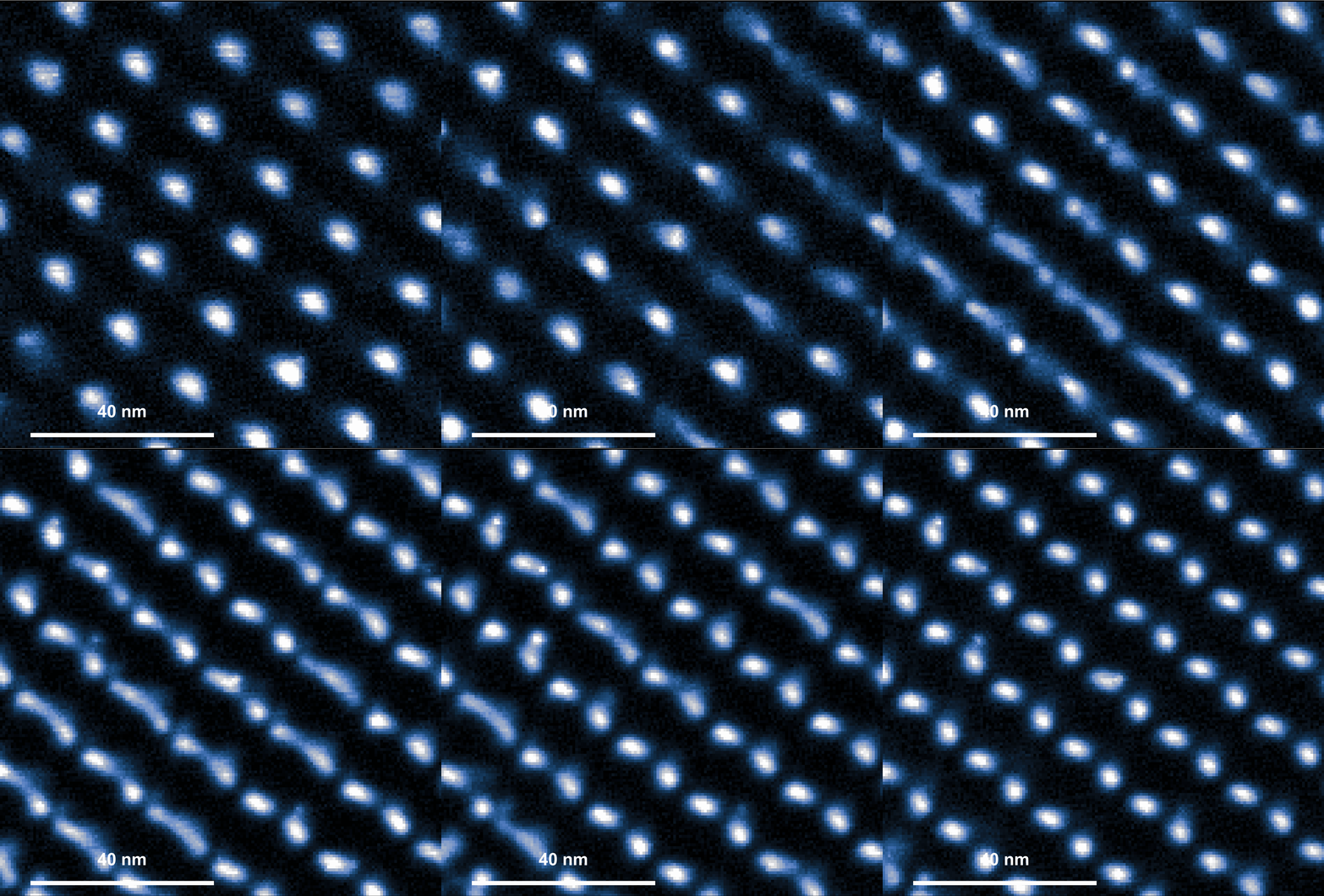
As the electron density is increased, Wigner molecules transform from one integer to the next through a process called “quantum densification.” The process resembles cell mitosis. (left) The melting of an N = 1 to an N = 2 Wigner molecular crystal. (right) The melting of an N = 2 to an N = 3 Wigner molecular crystal.